
Housing
Home Ownership
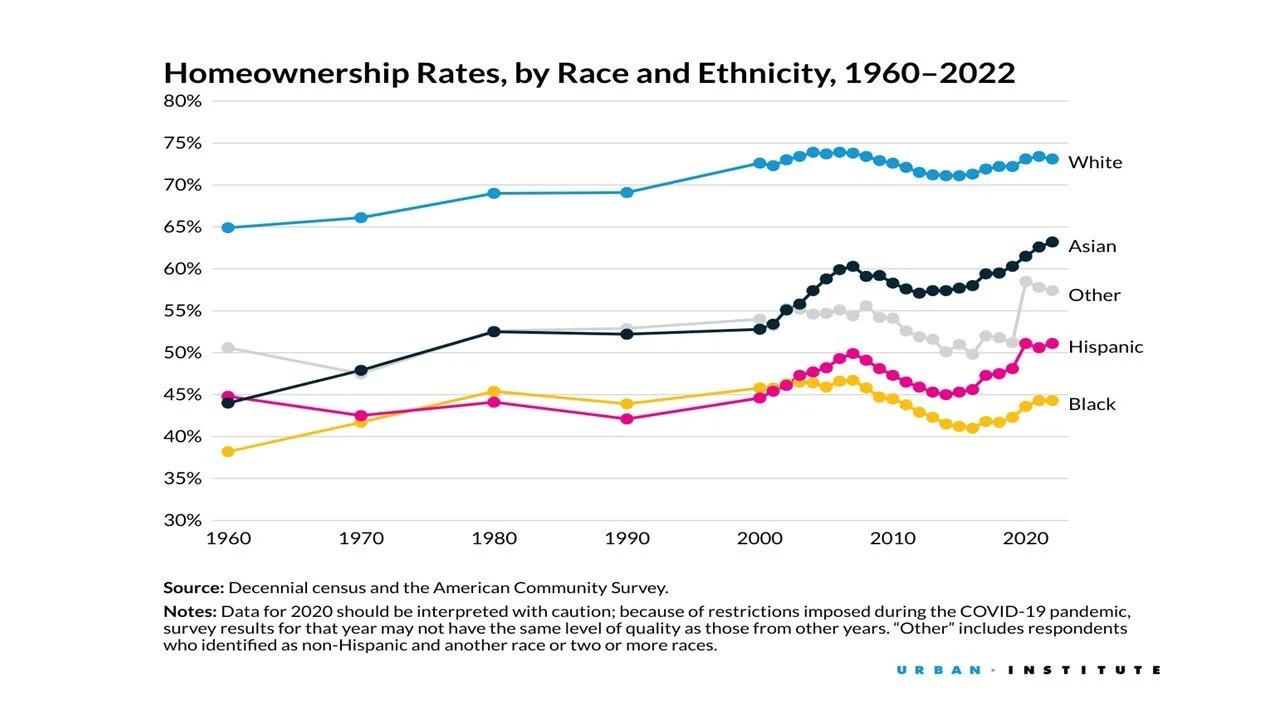
The middle class was grown through home ownership following WW2. The 15 and 30 year mortgages with 20% down payment versus the previous 50% down were created along with favorable tax policy and the GI Bill. Home ownership rose from 45% to over 65%. Now it is almost 75% for whites.
Blacks, however, were extensively excluded through federal policies such as real estate redlining, covenant title restriction and contract sales. Subprime loans disproportionately targeted Blacks, and loan discrimination continued until after the 1968 Fair Housing Act. An estimated 2.1 million Black GIs were excluded from the 1944 GI Bill which promoted VA home loans.
Middle Class New Deal, A Mechele Dickerson
(For the source and more facts and data, click here.)
Studies have shown that removing any decorations that could reveal a home is Black-owned is recommended for appraisals and potential buyers. Although lower appraisals are now against the law, unconscious bias still affects the appraisal process.
Professor Maria Krysan and her colleagues from the University of Illinois examined how people judge neighborhoods in a series of studies. One study showed White and Black people videos of identical neighborhoods, with actors posing as Black and White residents, and asked them to rate the neighborhoods. Even though White participants had previously said they wanted on average 47% diversity, “both the racially mixed and the all-Black neighborhoods were rated by Whites as significantly less desirable than the identical all-White neighborhood in the video.”
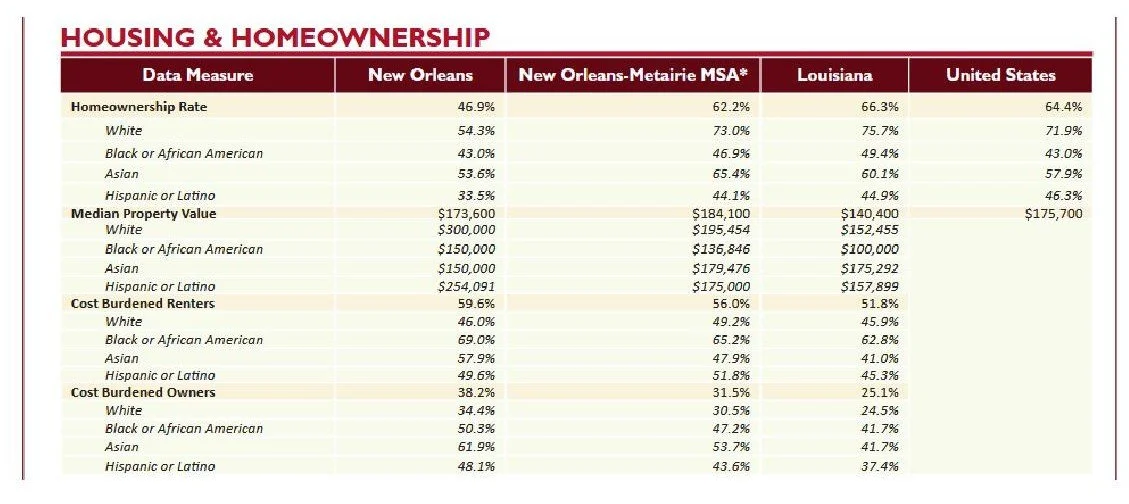
Fewer Blacks than Whites own their own homes, and those homes are half as valuable on average as white-owned homes. This diminishes their potential generational wealth and family prosperity.
Rental
Almost 70% of Black renters in New Orleans pay more than 30% of their income for rent. This diminishes their potential generational wealth and family prosperity.
Unhoused
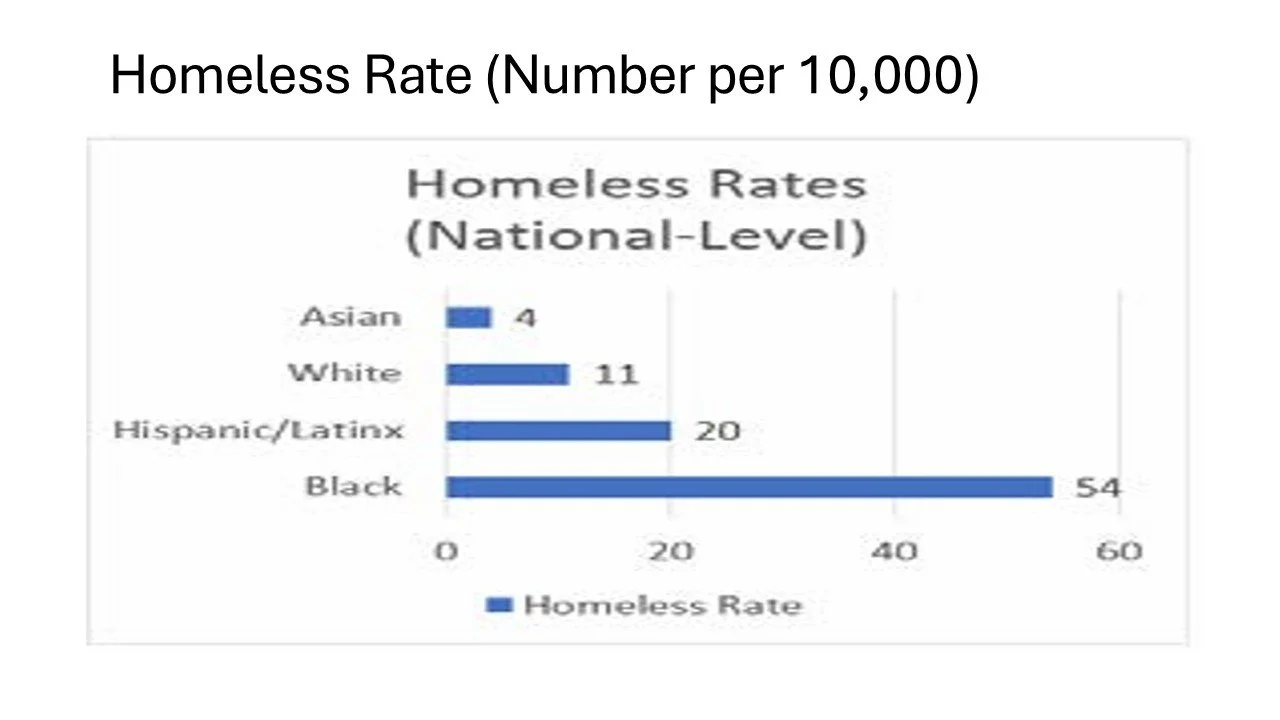
Blacks are 14% of the population but 40% of the homeless. Homelessness is driven by economic hardship, health issues and social factors such as breakdown of the family and lack of affordable housing.
In 2026, a new criminal offense was created by the Louisiana Legislature that applies to unhoused people and allows police to arrest or cite people for sleeping or living outdoors. House Bill 211 created a statewide ban on “public camping and temporary outdoor habitation.” The law created enforcement mechanisms, penalties for violating the ban and a new Homeless Court Program tied to the criminal process. While it does not say homelessness is illegal, it criminalizes the unavoidable behaviors of being unhoused. The Criminal Justice System is the primary intervention mechanism.
“Equal treatment in an unequal society could still foster inequality. Because Black men were disproportionately incarcerated and Black women disproportionately evicted, uniformly denying housing to applicants with recent criminal or eviction records still had an incommensurate impact on African Americans.”