
Education
Unlike in other nations, public education funding in the United States runs through the local tax base in ways that were designed to create inequitable public schools. And the design has fulfilled its intention, as the United States perpetuates one of the most inequitable education systems in the world.
Average funding was $14,277 per student in 2025. Predominantly Black schools are funded $902 per student less than predominantly White schools primarily due to the schools’ dependence on local taxes. Black students are 3.5x more likely to be in chronically underfunded schools.
39% of students of color attend high-poverty schools nationwide, a rate 12% higher than all students.
65% of low income Black students have broadband vs 82% of low income White students.
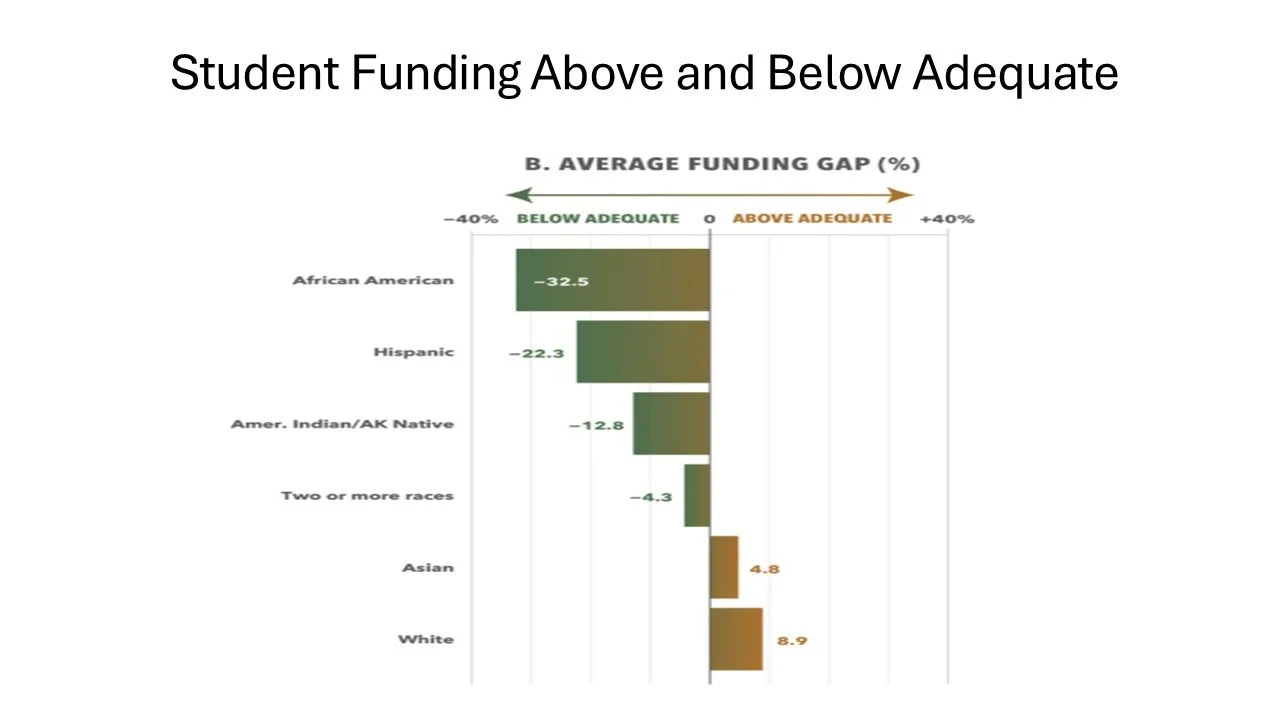
Only 15% of Black high school grads are prepared for college level math vs 52% of Whites.
Black students often receive harsher punishment than White peers. For example, suspension rates for Black students being caught with a cellphone were 40% compared to 17% for White students in one study.
Some teachers rate Black children’s academic capability well below White peers when they have identical scores.
Children from low-socioeconomic status households and communities develop academic skills more slowly than children from higher socioeconomic status groups, as reported by the American Psychological Association. [1]
The school systems in low-socioeconomic status communities are often under-resourced, which negatively impacts the academic progress and outcomes of the students they serve. [2] For example, children from low-socioeconomic status families enter high school with average literacy skills five years behind those of high-income students. [3]
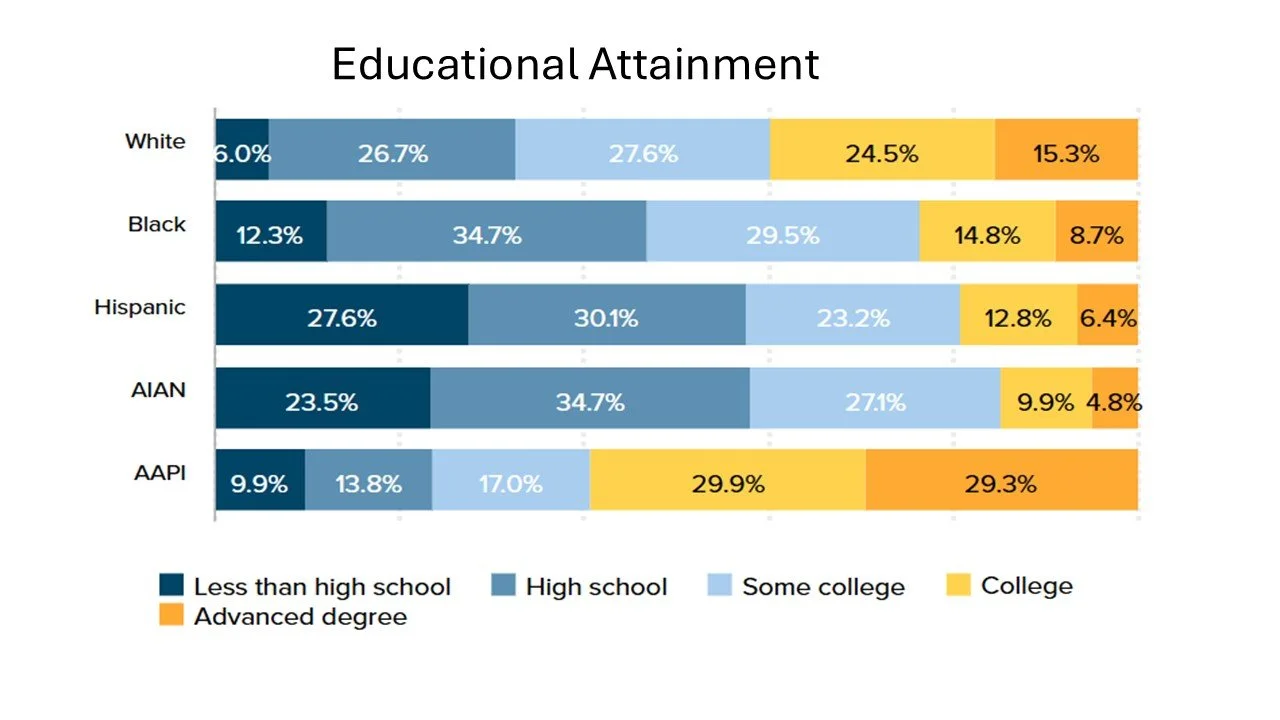
The Center for American Progress recommends 3 strategies for realizing a more equitable K‑12 academic landscape.
equitable funding via increasing federal funding for education and promoting fairer and more transparent funding policies at the state and local levels;
equipping schools with more counselors, nurses, and social workers rather than increasing
surveillance and policing; andupdating school boundaries and selection criteria to promote racial equity.
School-to-Prison Pipeline
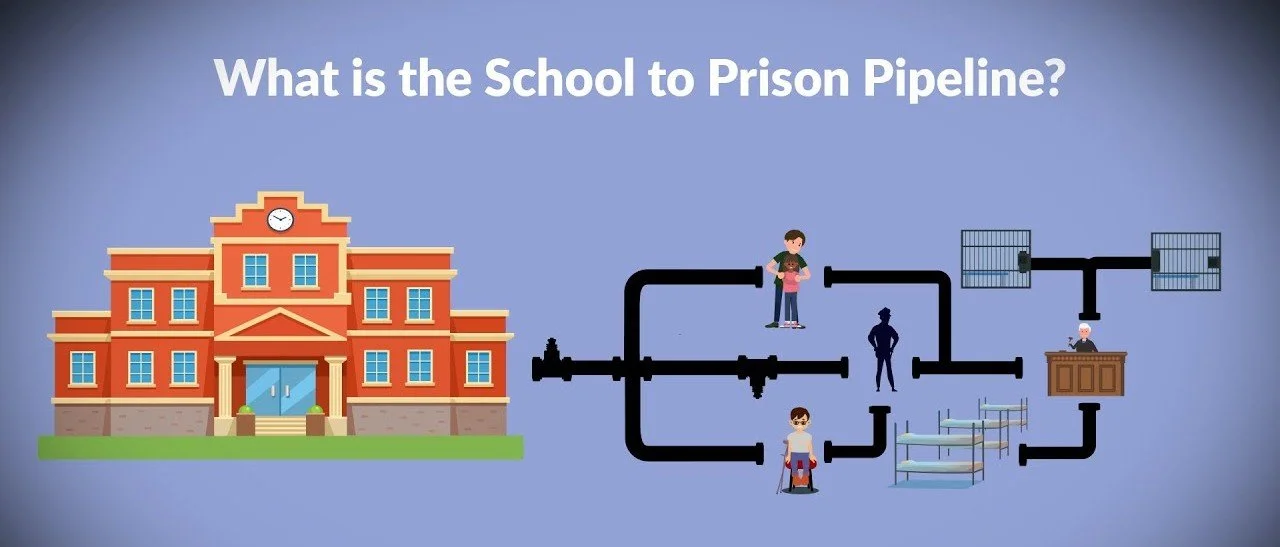
The school‑to‑prison pipeline is a well‑documented pattern in the U.S. where certain school disciplinary practices increase the likelihood that students—especially marginalized students—end up in the criminal justice system. The school‑to‑prison pipeline refers to policies and practices in schools—such as suspensions, expulsions, zero‑tolerance rules, and police involvement—that push students out of classrooms and into contact with law enforcement, increasing their chances of incarceration later in life.
Systemic factors:
Zero‑tolerance policies that mandate harsh punishment for even minor infractions. These policies often ignore context, developmental needs, or underlying issues.
Exclusionary discipline such as suspensions and expulsions remove students from the classroom, increasing disengagement and dropout risk. Students who fall behind academically are more likely to encounter the justice system.
Structural racism and bias Black, Indigenous, Latino, and disabled students are disciplined more harshly and more frequently than their peers—even for similar behavior. Black students are suspended or expelled three times more often than white students.
Educational inequality Under‑resourced schools—often in impoverished communities—tend to rely more heavily on punitive discipline rather than supportive interventions.
Police presence in schools The rise of school resource officers (SROs) means behaviors once handled by teachers or administrators are now criminalized. Minor misbehavior becomes grounds for arrest or juvenile detention.
The pipeline leads to:
Higher dropout rates
Criminalization of youth behavior creating a self‑reinforcing cycle.
Long‑term inequity The pipeline reinforces broader patterns of racial and socioeconomic inequality, undermining the idea of public education as a “great equalizer.”
This is not just an education issue—it’s a civil rights issue. It shapes life outcomes, perpetuates mass incarceration, and disproportionately harms communities already facing systemic disadvantages. Addressing it requires rethinking discipline, investing in supportive services, and confronting structural bias.
Education or Incarceration? How School Discipline Fuels the School-to-Prison Pipeline-Final
Was Moynihan right?
Conservative voices still quote Daniel Patrick Moynihan's 1965 report that the rise in single-mother households was a primary barrier to economic and social equality for African Americans. As a result many educators (and citizens) blame poor educational performance by Black children on the absence of a "father in the house." Funding is currently allocated in the federal budget to encourage marriage. Some government social programs require that recipients attend "marriage" classes in the effort to promote 2-parent homes. In the last decade at least 1.5 Billion dollars in TANF (Temporary Assistance to Needy Families aka Welfare) funds have been exclusively earmarked for marriage promotion!
Christina J Cross, Ph.D carried out extensive research to determine if the presence of 2 parents in the home of Black children made a difference 60 years after Moynihan's proclaimation. In her book Inherited Inequality: Why Opportunity Gaps Persist Between Black and White Youth Raised in Two-Parent Families (Harvard University Press, 2025), she compared children's accomplishments by 1 Parent and 2 Parent White, and 1 Parent and 2 Parent Black households. She found that Black children in 2 Parent homes do not perform better than Black children in 1 Parent homes or as well as White Children in 2 Parent Homes. She noted that African American children are often reared in households with substantially fewer resources than White children, even when they live in the same family structure. Dr. Cross reports that everything (including parent's income, amount of time spent with kids, mental health, etc.) is influenced by the American racial hierarchy. She found that White children's more favorable school outcomes are due to the privilege of growing up in a White-dominated society. The "deeply inequitable system" is more predictive of Black children's success than how many parents live in their home. Statistical reports show that White children of single parents are suspended and expelled less frequently than Black children with two parents. As long as we continue to fix the blame on individual parents rather than on systemic and institutional racism, Black children will continue to fail.
Is college only for the wealthy?
Currently, the quality of education a child in America receives is nearly predetermined by the private wealth and race of their parents. The basis of educational funding must shift from parental race and wealth to students’ needs. Educational inequities only get worse after high school. College is free to students whose parents are ready and able to pay increasing tuition rates plus a few academically exceptional students. No student can afford college today. Restricting college education to the wealthiest among us while financially punishing everyone else with educational ambitions is another generational crime against our children of the highest magnitude. That crime disproportionately damages the educational and wealth potential of Black people. (See Andre M. Perry, Marshall Steinbaum, and Carl Romer, “Student loans, the racial wealth divide, and why we need full student debt cancellation,” Brookings Institution, June 23, 2021,).
In another study of rising tuition costs by the Brookings Institution, they noted that graduate students face the sharpest increases in cost because they receive fewer grants and rely more on loans as tuition rises.
On July 1, 2026, policies for college and graduate-school student loans were dramatically changed and will worsen the opportunities people have for raising their socio-economic status. Experts have warned that “the new reductions in federal education loans will deepen existing racial, gender, and class inequities in college access. This is especially true for Black women, who rely more on student loans than other demographics. Overall, women hold an estimated two-thirds of the nation’s 1.8 trillion in student loan debt”, reported Nadra Nittle in The19th.
The new government policy established a “professional” designation for graduate degrees in medicine, law, and ministry. For other degrees such as social work, nursing, and education where women are the primary practitioners, borrowers are limited to $20,500 annually, and no more than $100,000 in a lifetime. For designated professional degrees, limits are more than doubled to $50,000 annually and $200,000 lifetime. Masters degrees are required for licensed social workers to have a private practice and bill insurance companies. Likewise, for teachers and nurses to advance in their fields and qualify for higher salaries, they must complete graduate school.
The new guidelines for student loans also have negative implications for parents who previously could borrow all the funds needed to cover higher education for their children. Now, they are restricted to $20,000 annually and $65,000 per student.
With the new loan restrictions, fewer Black women will be able to “lift themselves up by their bootstraps.”
“We have to move beyond that charitable mindset of sprinkling resources. Giving backpacks to kids is good, but we also have to go deeper in our analysis about the historical and systematic problems that are in place that actually lead to disparities in education for kids of color.”
— Edgar Villanueva